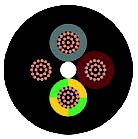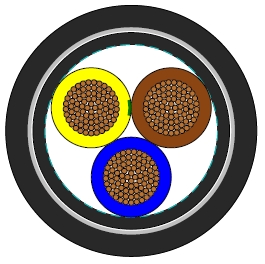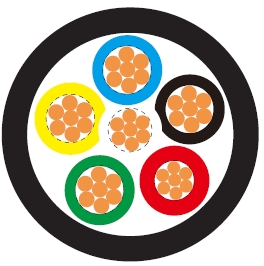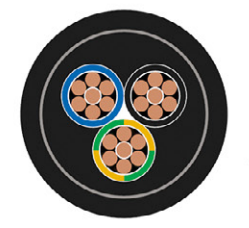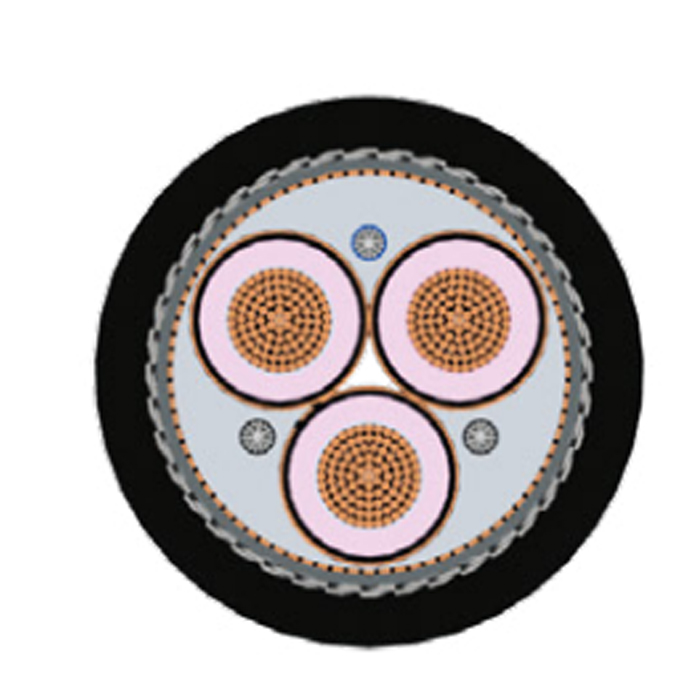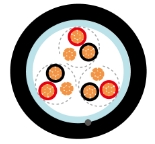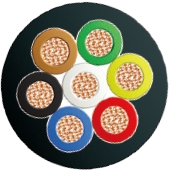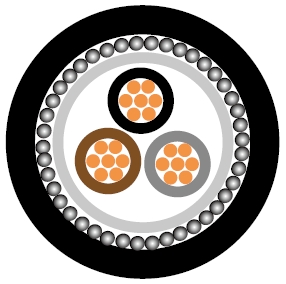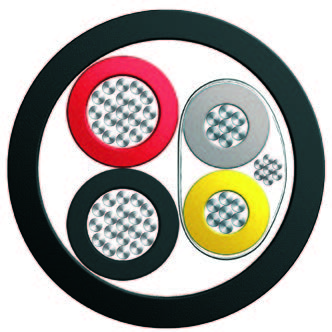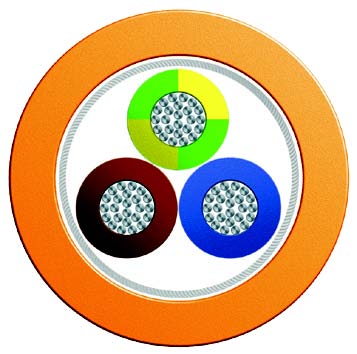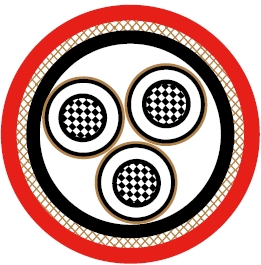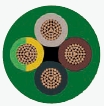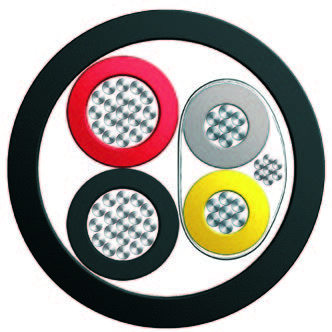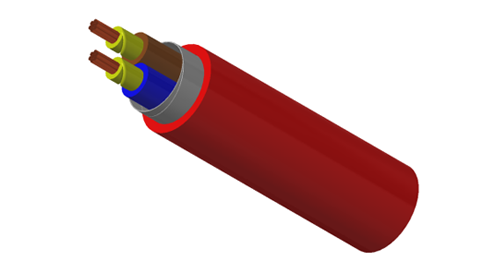
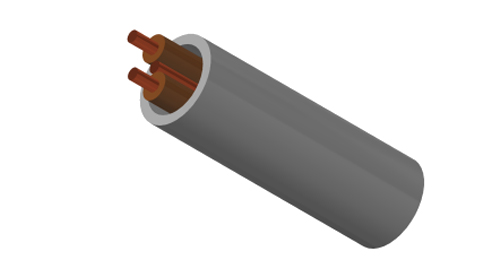
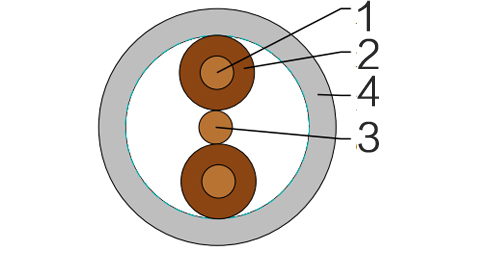
BURY CABLE BS 7211 300/500V cable is intended for fixed power and lighting wiring in buildings where low smoke and low corrosive gas emission are specified. The construction uses 2 or 3 XLPE insulated copper cores, an additional uninsulated copper circuit protective conductor (CPC), and an LSZH outer sheath.
Typical applications include fixed wiring in commercial and public buildings. This is an unarmoured cable: assess the installation route and provide mechanical protection where required. Select the conductor size, CPC size and protective device together with the circuit load, voltage drop and installation conditions.
LSZH and flame-retardant characteristics do not, by themselves, establish continued circuit operation during a fire. Where an emergency circuit requires fire resistance or circuit integrity, specify a cable supported by the required test evidence.
Rated voltage: 300/500V, with basic design to BS 7211:2012 as listed below.
Core arrangement: 2 or 3 insulated cores plus a separate bare copper CPC; the CPC is additional to the insulated core count.
Conductors and insulation: annealed copper, Class 1 or Class 2 as tabulated, with XLPE insulation.
Sheath: LSZH type LTS 2; optional sheath properties must be specified when ordering.
Selection data: construction dimensions, CPC cross-sections, current-carrying capacities and voltage-drop values are retained in the tables below.
Basic design to BS 7211:2012
| Flame Retardance (Single vertical wire or cable test) | IEC 60332-1-2; EN 60332-1-2 |
| Reduced Fire Propagation (Vertically-mounted bundled wires & cables test) | IEC 60332-3-24; EN 60332-3-24 |
| Halogen Free | IEC 60754-1; EN 50267-2-1 |
| No Corrosive Gas Emission | IEC 60754-2; EN 50267-2-2 |
| Minimum Smoke Emission | IEC 61034-2; EN 61034-2 |
300/500V
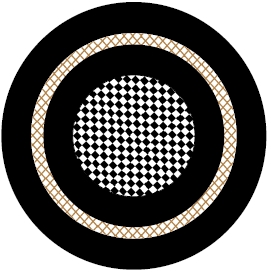
Conductor : Annealed copper conductor, solid or stranded according to BS EN 60228 class 1 or class 2.
Insulation : XLPE type GP8 according to BS 7655-1.3. Crosslinked polyolefin material type EI 5 according to EN 50363-5 can be offered as option.
CPC (Circuit Protective Conductor) : Uninsulated copper conductor.
Outer Sheath : Extruded LSZH type LTS 2 according to BS 7655-6.1.
Outer Sheath Option : UV resistance, hydrocarbon resistance, oil resistance, anti-rodent and anti-termite properties can be offered as option.
Insulation Colour :
Twin : Brown and blue or, for 2x1.0 and 2x1.5 cables, brown and brown.
Three cores : Brown, black (centre core) and grey.
Position of CPC :
Twin : Centrally placed between cores in same plane.
Three cores : Centrally placed between black and grey cores in same plane.
Sheath Colour : White; other colours can be offered upon request.
Maximum temperature range during operation : 90°C
Maximum short circuit temperature (5 Seconds) : 250°C
Minimum bending radius :
OD<8mm : 4 × Overall Diameter
8mm≤OD≤12mm : 5 × Overall Diameter
OD>12mm : 6 × Overall Diameter
| Conductor | FLP300-RZ1-U/R | |||||||
|---|---|---|---|---|---|---|---|---|
| No. of Cores × Cross-sectional Area | Conductor Class | Nominal Insulation Thickness | Cross-sectional Area of CPC | Class of CPC | Nominal Sheath Thickness | Min. overall Dimensions | Max. overall Dimensions | Approx. Weight |
| No.×mm² | mm | mm² | mm | mm | mm | kg/km | ||
| 2×1.0 | 1 | 0.7 | 1.0 | 1 | 0.9 | 4.1×7.6 | 5.0×9.2 | 68 |
| 2×1.5 | 1 | 0.7 | 1.0 | 1 | 0.9 | 4.4×8.1 | 5.3×9.7 | 85 |
| 2×2.5 | 1 | 0.7 | 1.5 | 1 | 1.0 | 4.9×9.3 | 6.0×11.2 | 120 |
| 3×1.0 | 1 | 0.7 | 1.0 | 1 | 0.9 | 4.1×10.0 | 5.0×12.1 | 91 |
| 3×1.5 | 1 | 0.7 | 1.0 | 1 | 0.9 | 4.4×10.7 | 5.3×12.9 | 115 |
| 3×2.5 | 1 | 0.7 | 1.5 | 1 | 1.0 | 4.9×12.0 | 6.0×14.6 | 170 |
| 2×1.0 | 2 | 0.7 | 1.0 | 1 | 0.9 | 4.2×7.8 | 5.1×9.4 | 73 |
| 2×1.5 | 2 | 0.7 | 1.0 | 1 | 0.9 | 4.5×8.3 | 5.4×10.0 | 90 |
| 2×2.5 | 2 | 0.7 | 1.5 | 1 | 1.0 | 5.0×9.5 | 6.1×11.4 | 125 |
| 2×4 | 2 | 0.7 | 1.5 | 1 | 1.0 | 5.5×10.4 | 6.7×12.6 | 175 |
| 2×6 | 2 | 0.7 | 2.5 | 1 | 1.1 | 6.2×12.0 | 7.5×14.6 | 240 |
| 2×10 | 2 | 0.7 | 4.0 | 2 | 1.2 | 7.3×14.5 | 8.8×17.5 | 390 |
| 2×16 | 2 | 0.7 | 6.0 | 2 | 1.3 | 8.4×17.0 | 10.1×20.5 | 560 |
| 3×4 | 2 | 0.7 | 1.5 | 1 | 1.0 | 5.5×14.0 | 6.7×16.9 | 196 |
| 3×6 | 2 | 0.7 | 2.5 | 1 | 1.1 | 6.2×16.2 | 7.5×19.5 | 291 |
| 3×10 | 2 | 0.7 | 4.0 | 2 | 1.2 | 7.3×19.5 | 8.8×23.6 | 440 |
| 3×16 | 2 | 0.7 | 6.0 | 2 | 1.3 | 8.4×22.8 | 10.1×27.6 | 670 |
Conductor operating temperature : 90°C
Ambient temperature : 30°C
| Conductor Cross-sectional area | Ref. Method A (enclosed in conduit in thermally insulating wall etc.) | Ref. Method B (enclosed in conduit on a wall or in trunking etc.) | Ref. Method C (clipped direct) | Ref. Method E (free air or on a perforated cable tray etc. horizontal or vertical) | ||||
|---|---|---|---|---|---|---|---|---|
| 1 two-core cable*, single-phase a.c. or d.c. | 1 three-or four core cable*, three- phase a.c. | 1 two-core cable*, single- phase a.c. or d.c. | 1 three-or four core cable*, three-phase a.c. | 1 two-core cable*, single-phase a.c. or d.c. | 1 three-or four core cable*, three- phase a.c. | 1 two-core cable*, single- phase a.c. or d.c. | 1 three-or four core cable*, three- phase a.c. | |
| 1 | 2 | 3 | 4 | 5 | 6 | 7 | 8 | 9 |
| mm² | A | A | A | A | A | A | A | A |
| 1.0 | 14.5 | 13 | 17 | 15 | 19 | 17 | 21 | 18 |
| 1.5 | 18.5 | 16.5 | 22 | 19.5 | 24 | 22 | 26 | 23 |
| 2.5 | 25 | 22 | 30 | 26 | 33 | 30 | 36 | 32 |
| 4 | 33 | 30 | 40 | 35 | 45 | 40 | 49 | 42 |
| 6 | 42 | 38 | 51 | 44 | 58 | 52 | 63 | 54 |
| 10 | 57 | 51 | 69 | 60 | 80 | 71 | 86 | 75 |
| 16 | 76 | 68 | 91 | 80 | 107 | 96 | 115 | 100 |
Note: With or without a protective conductor.
| Conductor cross-sectional area | Two-core cable, d.c. | Two-core cable, single-phase a.c. | Three or four core cable, three-phase a.c. |
|---|---|---|---|
| 1 | 2 | 3 | 4 |
| mm² | mV/A/m | mV/A/m | mV/A/m |
| 1.0 | 46 | 46 | 40 |
| 1.5 | 31 | 31 | 27 |
| 2.5 | 19 | 19 | 16 |
| 4 | 12 | 12 | 10 |
| 6 | 7.9 | 7.9 | 6.8 |
| 10 | 4.7 | 4.7 | 4.0 |
| 16 | 2.9 | 2.9 | 2.5 |
Specify cores and CPC separately. State 2 or 3 insulated cores, their cross-sectional area, and the required CPC area. The CPC is not necessarily the same size as the insulated conductors; refer to the construction table.
Check circuit ratings. Assess load current, voltage drop, fault protection and the installation method. Apply the relevant ambient-temperature, grouping and installation correction factors; do not use the tabulated current as a universal rating.
Check the reference basis. The electrical tables below retain their original BS 7671:2008 references. Confirm suitability against the wiring rules and project specification applicable to the installation.
Confirm the route and environment. This product is unarmoured. Outdoor exposure, direct burial, water, oil or other environmental demands require a separate suitability check. Optional UV, oil and other sheath properties are not automatic features of the standard construction.
Confirm fire requirements. Match the specified smoke, halogen and flame tests to the required evidence. Do not substitute an LSZH wiring cable for a specified fire-resistant circuit cable solely on the basis of sheath material.
For a quotation: provide the core count and sizes, CPC size, conductor class, required length, core and sheath colours, installation conditions, applicable standard edition and any required test documentation.
450/750V BS 7211 single-core XLPE LSZH cable - compare for installations that call for separate single-core conductors. Confirm the different voltage rating and earthing arrangement.
BS 7211 circular multicore cables - compare where a circular construction or a different core arrangement is specified; verify the exact product data before substitution.
300/500V BS 7629-1 silicone rubber insulated, screened LSZH fire-resistant cable - a different construction to consider when the project requires fire resistance. Confirm the required test classification and supporting reports.
What does 2 or 3 cores mean on this page?
The count refers to the XLPE insulated conductors. A separate bare copper CPC is also included. Its cross-sectional area is shown in the construction table.
Is the CPC insulated?
No. The listed construction uses an uninsulated copper CPC. Confirm its size and termination requirements as part of the circuit design.
Is this cable armoured or suitable for direct burial?
It is unarmoured. This page does not establish suitability for direct burial. Check the route, mechanical protection and environmental requirements before choosing the cable.
Does LSZH mean the cable will keep working during a fire?
No. LSZH describes smoke and halogen-related properties. A circuit-integrity or fire-resistance requirement needs separate supporting test evidence. Select a cable with documented performance matching the specified requirement.
Can the current-carrying table be used for every installation?
No. It has a stated temperature and installation-method basis. Select the appropriate column, apply relevant correction factors, and check voltage drop, fault protection and the applicable wiring rules.
What information should I send with an enquiry?
Include the number and size of insulated cores, CPC size, conductor class, cable length, colours, installation conditions and any specified tests or optional sheath properties. This helps identify the correct construction and documentation.